Vibe Coding’s 80/20 Rule : The Final 20% That Turns a Prototype into a Product
- Author:Hashtrust Technologies
- Published On:Aug 21, 2025
- Category:Productivity
Rapid coding gets you started. The last 20% ensures you last.
In software development, speed can be thrilling. With modern code-generation tools and AI-assisted coding, teams can build a working prototype in hours instead of weeks. This rapid approach, often called vibe coding, can deliver 80 percent of your application in minutes. That early progress can be exciting, energizing, and convincing enough to show to stakeholders.
But the remaining 20 percent is where the real test begins. This part is slower, more complex, and critical for business survival. If ignored or rushed, it can lead to costly mistakes that outweigh the benefits of the fast start.
What Vibe Coding Does Well
Vibe coding shines in the early stages. It is perfect for:
- Building a basic user interface and core functions
- Creating simple data flows
- Demonstrating happy path scenarios where everything works perfectly
- Implementing prototype-level features for demos or validation
For example, imagine launching a demo version of an e-commerce app to pitch to investors. With vibe coding, you can show them a live shopping cart, a product list, and a payment screen in just a day. At this point, the goal is to validate the concept, not to withstand the load of thousands of daily shoppers.
The Final 20%: Where Complexity Lives
The last part of the journey covers areas that are often invisible to users but essential for success:
- Security and authentication mechanisms
- Data governance and privacy protections
- Error handling for every possible failure scenario
- Performance tuning for high-traffic situations
- Integration with existing systems or third-party services
- Compliance with legal and regulatory requirements
These are the features that transform a functional demo into a robust product. Without them, a system may work in the lab but fail in production. For example, a messaging app might handle 50 users flawlessly, but without proper scaling and error handling, it could crash under real-world traffic.
Enterprise Software is More Than Features
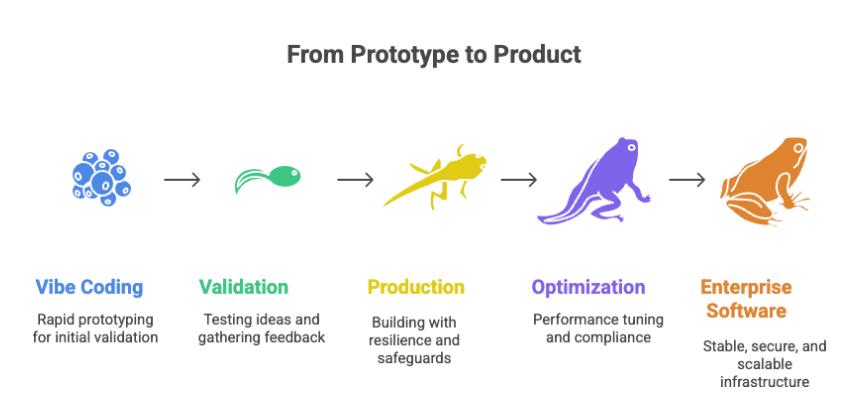
A prototype shows possibilities, but enterprise-grade software requires infrastructure that is stable, secure, and able to grow with the business. This includes load balancing, monitoring, automated testing, and disaster recovery plans. In short, features attract users, but infrastructure keeps them.
The Right Way to Use Vibe Coding
The most successful teams treat vibe coding as a tool for exploration and validation. They use it to test ideas, get quick feedback, and prove concepts. Once validated, they shift to building with resilience in mind, adding safeguards, optimizing performance, and meeting compliance needs.
The Risk of Skipping the Transition
Teams that fail to move beyond vibe coding often end up with software that looks polished but is fragile under pressure. This is a dangerous position, especially for products that aim to serve a large customer base or handle sensitive data.
How Hashtrust Ensures You Deliver More Than Vibes
At Hashtrust, we combine the speed of modern development techniques with the discipline of enterprise software engineering. We have built numerous projects using AI agents, autonomous systems, and scalable architectures.
Our approach is simple:
- Rapidly prototype to validate your idea
- Transition to production-grade development that meets security, performance, and compliance standards
- Leverage our AI and multi-agent expertise to build systems that scale and adapt to your needs
Whether you are creating a proof of concept or a fully operational platform, we help you move from fast ideas to dependable products. You get the best of both worlds: speed at the start and strength for the long run.
If you are ready to turn a quick prototype into a market-ready, resilient solution, reach out to us at support@hashtrust.in. Together, we can build software that lasts.